
7 Steps to Recruit Volunteers for Local Events
Last Updated: November 1, 2026
Quick Summary
To recruit volunteers for local events, write a clear role description for each job before you ask anyone to sign up. Then work backward from your event date with a timeline that opens sign-ups six weeks out and fills most shifts four weeks out.
- Write each role description with one task, shift length, and physical demands listed upfront.
- Open sign-ups six weeks before the event to build a committed core of volunteers.
- Push community outreach hardest four weeks out, when most rosters fill.
- Staff above your minimum so one no-show does not break a zone.
- Send thank-yous within 24 hours and invite people to the next event.
Table of Contents
- Start With Volunteer Role Descriptions for Events
- Build a Volunteer Recruitment Timeline
- Where to Find Volunteers: Channels That Actually Work
- Creative Ways to Recruit Volunteers Beyond the Usual Post
- Write an Event Volunteer Recruitment Message Template
- Screen, Train, and Supervise on Event Day
- Recruit Volunteers Who Come Back: Follow-Up and Retention
- Post Your Event and Fill Your Volunteer Roster
- Frequently Asked Questions
Start With Volunteer Role Descriptions for Events
Most event teams lose volunteers before anyone signs up. The reason is simple: vague asks get vague answers. When you learn how to recruit volunteers for local events, the first move isn’t a post or a flyer. It’s a clear role.
Organizers often post “help needed” and wonder why the inbox stays quiet. Specific beats general every time.
A volunteer role description is a short, plain-language document that names one job, its time commitment, and what success looks like. Write it before you recruit a single person.
What Every Role Description Needs
Keep each description to a few lines. Volunteers scan. They don’t read.
- Role title in plain words: “Check-in table lead,” not “Guest experience associate”
- Shift length and start time
- Physical demands: standing, lifting, walking
- One clear task the person owns
- Who they report to on site
- What to wear and bring
A common mistake is stuffing three jobs into one role. Don’t. Split setup, greeting, and cleanup into separate asks. You’ll fill more slots.
Skipping the physical demands line can lead to no-shows and injuries on event day. Say it upfront.
Build a Volunteer Recruitment Timeline
Work backward from your event date. A realistic volunteer recruitment timeline gives you room to fill gaps without panic. The table below is the skeleton. The week-by-week detail under it is what actually keeps a roster full.
| When | Action | Goal |
|---|---|---|
| 8 weeks out | Write role descriptions | Know exactly what you need |
| 6 weeks out | Open sign-ups | Early committed core |
| 4 weeks out | Push community outreach | Fill most shifts |
| 2 weeks out | Confirm and send details | Lock the roster |
| 1 week out | Fill last-minute gaps | Full coverage |
| Day after | Send thank-yous | Set up retention |
The Week-by-Week Checklist
8 weeks out. Write every role description. Count stations, shifts, and headcount per shift. Decide who supervises each zone. Build your sign-up form and your standby list structure now, not later.
6 weeks out. Open sign-ups. Post roles on your site and social channels. Send the first ask to past volunteers and supporters. Goal: a committed core you can build around.
4 weeks out. Push community outreach hard. Table at neighborhood markets, hit church and block-club contacts, and ask every confirmed volunteer for one referral. This is the week most rosters fill.
2 weeks out. Confirm everyone in writing. Send shift time, location, parking or transit notes, what to wear, and who to report to. Lock the roster and start your standby list.
1 week out. Fill last-minute gaps. Text your standby list one slot at a time. Reconfirm the people most likely to flake and have a backup name ready for every critical station.
Day after. Send thank-yous within 24 hours. Share one photo or a quick result. Invite people to the next event before the feeling fades.
Staffing Math and Contingency Planning
Count your stations, then add a buffer. If a station needs two people across a four-hour event, plan for three. People get sick. Traffic happens. A common practice is to staff somewhat above your minimum so a single no-show doesn’t break a zone.
Build a standby list of two or three flexible volunteers. Give them a simple text when a slot opens.
Assign one point person per zone and give every volunteer a direct number to call if they can’t make it. A no-show you hear about at 7 a.m. is a problem you can solve. A no-show you discover at doors-open is a crisis.
Where to Find Volunteers: Channels That Actually Work
The best volunteer channels mix digital reach with real relationships. One alone rarely fills a roster.
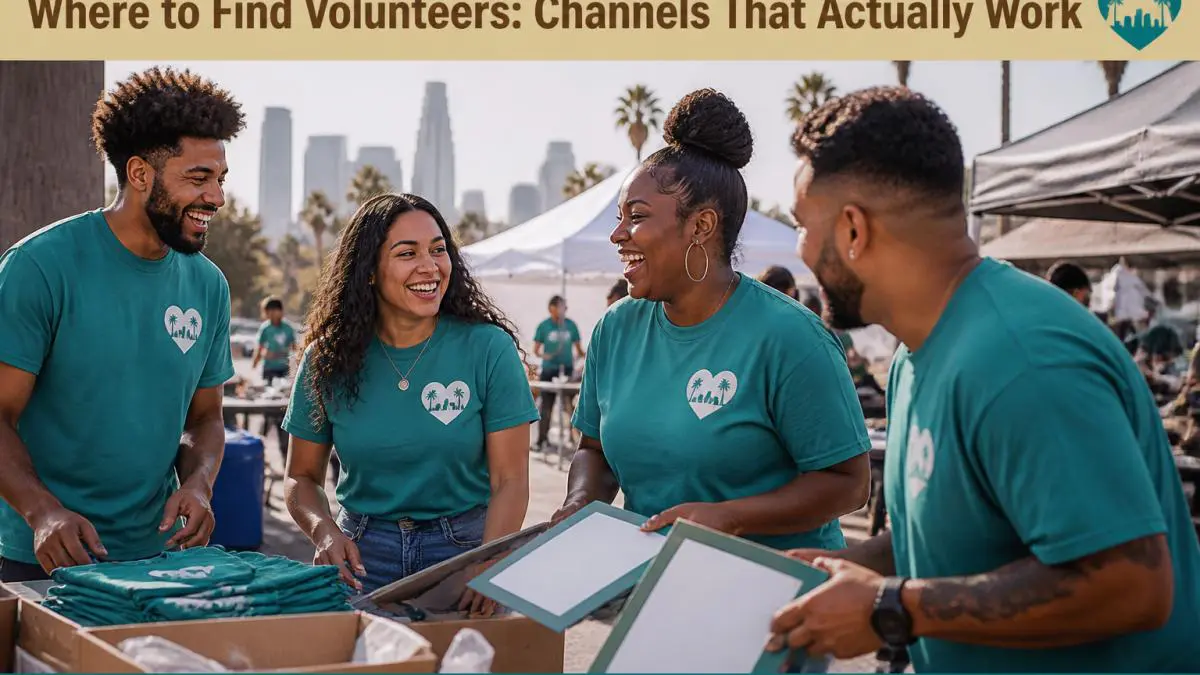
Start with your own circle. Past volunteers, supporters, and attendees already believe in the work. Then widen out:
- Social media: post roles, not just event promos
- Your organization website: a simple sign-up page
- Local volunteer centers and matching websites: good for first-timers
- Community organizations and church partnerships: the strongest source of reliable people
- Referrals: ask every volunteer to bring one friend
For deeper community building, see our guide on building community through local events.
Creative Ways to Recruit Volunteers Beyond the Usual Post
A flyer and a post only go so far. Creative ways to recruit volunteers come from meeting people where they already are.
Try these:
- Table at neighborhood markets and cultural festivals
- Partner with schools, churches, and block clubs
- Offer a small perk: food, a shirt, priority entry
- Host a short meet-and-greet before the event
- Ask local creators to share your call for help
Mission alignment matters more than perks. People show up for a cause they feel. Say what the event does for the community, plainly.
If your outreach feels flat, our tips on marketing free events to local neighborhoods can help sharpen your message.
Write an Event Volunteer Recruitment Message Template
A strong event volunteer recruitment message template removes friction. It tells people what, when, where, and how in seconds.
Use this and fill in the blanks:
Hi [Name], we’re putting on [Event Name] on [Date] and need help with [Role]. The shift runs [Start] to [End] at [Location]. You’d be handling [one task]. We’ll provide [food, shirt, training]. Interested? Reply yes and I’ll send details.
Keep it short. One role per message. One clear ask.
Want more eyes on your event first? Read our tips on increasing event visibility for small creators so your call reaches the right crowd.
Screen, Train, and Supervise on Event Day
Safety and clarity protect everyone. Screen lightly but deliberately. The goal isn’t a background check on every greeter. It’s matching the level of screening to the level of risk in the role.
Screen to the Role
- Low-risk roles (check-in, setup, cleanup): ask about experience and availability, confirm they can meet the physical demands, and get an emergency contact.
- Elevated-risk roles (working with minors, handling money, driving, medical support): require references, a background check where appropriate, and a named supervisor who signs off.
- Minors volunteering: confirm age requirements and get a parent or guardian signature on the waiver before event day.
Share the schedule and role expectations in writing. A text thread is not a briefing. Send a one-page role sheet with time, location, task, dress code, and who to report to.
Train Before Doors Open
Run a short orientation before the event. Fifteen to twenty minutes is enough. Cover the layout, the one task each person owns, the check-in and check-out procedure, where the bathrooms and water are, and how to flag a problem. Walk the floor with your zone leads so they know their stations.
Supervise on Event Day
Assign one point person per zone. Check in every hour. Give volunteers a clear way to flag problems, a group text, a radio channel, or a single number to call.
- Check-in: log every volunteer in and out so you know who is on site.
- Emergency contacts: keep a printed list at the command station, not just on a phone.
- Breaks and water: schedule them. Burned-out volunteers quit mid-shift and don’t come back.
Leaving volunteers unsupervised at busy stations causes confusion and burnout. Walk the floor yourself. A visible organizer who checks in keeps a team steady when the crowd surges.
After the event, debrief your zone leads while it’s fresh. Note what broke, who stepped up, and what you’d change. That notes file is the start of next year’s plan.
Recruit Volunteers Who Come Back: Follow-Up and Retention
Retention is where most teams drop the ball. Volunteer engagement doesn’t end when the event does.
Send a thank-you within a day. Share one photo or a quick result. Then invite them to the next event before they forget how good it felt.
- Recognize people by name
- Ask for feedback
- Track who showed up and who flaked
- Build a simple volunteer list you reuse
For the cultural side of retention, our guide on what makes an event culturally authentic explains why some events keep people coming back.
Post Your Event and Fill Your Volunteer Roster
Good events run on people who feel seen and prepared. Learn how to recruit volunteers for local events and you’ll scramble less for help. Clear roles, a real timeline, and honest follow-up do the heavy lifting.
That’s where Reach LA Angels comes in. We spotlight community-driven events across the city and connect organizers with audiences who care. Our curated listings, focus on Black and Brown communities, and platform for local creators are built to give your event visibility. When you’re ready to get the word out, our Event Promotion Services put your call for volunteers in front of the right people. Post your event, fill your roster, and keep the city connected.
Post your event today and get your call for volunteers in front of people ready to show up.
Frequently Asked Questions
How far in advance should you recruit volunteers for an event?
Start building your volunteer recruitment timeline six to eight weeks before event day. That gives you time to define roles, reach out through community organizations and social media, screen applicants, and confirm shift coverage. For larger events or specialized roles, begin ten to twelve weeks out. Keep a short list of last-minute backups, because cancellations happen and a filled roster in week one does not guarantee a filled roster on event morning.
What should a volunteer recruitment message include?
A strong event volunteer recruitment message template covers five things: the event name and date, the specific role and shift hours, what the volunteer will actually do, what they get out of it (meals, parking, recognition, community impact), and a clear sign-up link or contact. Keep it short and personal. Name the neighborhood and the audience so people can see themselves in the work. One message with all five details beats five vague posts.
What are some creative ways to recruit volunteers for a local event?
Go where your community already gathers. Partner with churches, block clubs, and cultural organizations for referrals. Ask past volunteers to bring a friend. Offer group sign-ups for teams, sororities, or coworkers. Set up a table at neighborhood events and farmers markets. Post short video clips of last year’s event showing volunteers in action. Recognition matters too: public thank-yous and small perks like food and swag turn one-time helpers into regulars.
How do you keep volunteers engaged before and during the event?
Communication is the whole game. Send a confirmation right after sign-up, a reminder with parking and check-in details a few days out, and a thank-you within 48 hours after the event. On event day, assign a point person per shift, hand out a simple schedule, and check in on your volunteers in person. People stay engaged when they feel expected, prepared, and appreciated, not when they are guessing where to stand.
Ready to fill your next roster with people who actually care? Reach LA Angels helps local organizers gain visibility with curated listings, a platform built for creators, and a community that shows up. Get started with Reach LA Angels and put your event in front of the right crowd.
