
What Makes an Event Culturally Authentic: A 2026 Guide
Table of Contents
- What Culturally Authentic Really Means
- Cultural Sensitivity in Event Planning Starts With Consent
- Why Community-Led Events Outperform Curated Ones
- Cultural Event Examples That Get It Right
- Cultural Appropriation in Events: How to Spot and Stop It
- The Authenticity Audit: A Step-by-Step Check Before You Announce
- Budgeting, Fair Compensation, and Post-Event Accountability
- Conclusion
- Frequently Asked Questions
Last Updated: October 17, 2026
What Culturally Authentic Really Means
A culturally authentic event is one where the community being represented holds real power over how they are shown, paid, and credited. Not consulted after the flyer drops. Not thanked in a caption. Power, early and often.
At Reach LA Angels, we’ve watched planners chase authenticity as a look. The drummers, the fabric, the food truck. That’s decor. Authenticity is a decision-making process, and you can audit it.
Here’s the short version: cultural authenticity in events is the practice of giving a community authorship over its own representation, from planning through payment. Everything below flows from that.
Authenticity Is Accountability, Not Aesthetic
Aesthetics photograph well. Accountability holds up under scrutiny.
Ask yourself one question about any cultural element in your event: who decided this? If the answer is “our marketing team,” you have a prop, not a practice. If the answer is “the community partner who also set the budget line,” you have something real.
What most guides miss is that authenticity is measurable. You can score it. We’ll show you how.
Cultural Sensitivity in Event Planning Starts With Consent
Consent is the first step, and it comes before the venue contract, not after.
Cultural sensitivity in event planning means asking a community what they want represented before you build anything. But “asking” is where most planners get sloppy. Here is the process we actually run.
Find the right people, not the loudest ones
A strong social presence is not the same as standing in the community. Look for people who do the work year-round: the cultural center director, the longtime instructor, the organizer who runs the same program every season. Ask two or three separate sources who they trust to speak for a tradition. If the names overlap, you found your partner. If they don’t, keep asking.
A common pattern is treating one willing community member as a spokesperson for everyone. One person is one person. Ask directly: who else needs to be in this room? Elders, youth, and practitioners often hold different pieces of the same tradition.
Put the agreement in writing
A consent record does not need to be a legal contract. It needs to be clear. Ours covers:
- What is approved. Specific elements, not a blanket yes.
- What is off-limits. Sacred practices, restricted imagery, certain songs or regalia that should not be staged.
- Who approved it. Names and roles, so there is no confusion later.
- When it was approved. Traditions have boundaries that shift with context, so date the record and revisit it.
- How the partner is credited and paid. Consent without compensation is extraction with paperwork.
Handle sacred and restricted practices with a hard no
Some things are not for public viewing. If a partner tells you a practice is restricted, the answer is not “how do we adapt it for the stage.” The answer is no. Build the program around that boundary instead of negotiating it down. This is where events get into trouble, sacred imagery on a drink menu, a ceremonial object used as a prop. Once that image is public, an apology does not undo it.
Pay for the consultation
Asking a community to educate your team is labor. Budget for it like labor. Cultural advisors, translators, and elders who review your program should be compensated for their time, not thanked in a caption. If the culture is the draw, the people who carry it should see the value.
Skipping the consent step is how events end up with sacred imagery on a drink menu. Once that image is public, an apology does not undo it.
Keep your consent record with the event file, not buried in an email thread. When a vendor or sponsor asks why something is off the table, you can point to a document instead of a memory.
Why Community-Led Events Outperform Curated Ones
Community-led events draw deeper engagement because the audience can feel the difference between a production and a homecoming.
When the community builds the program, three things happen. Attendance becomes loyalty. Word of mouth gets louder. And the event survives its first year, because the people who made it will defend it.
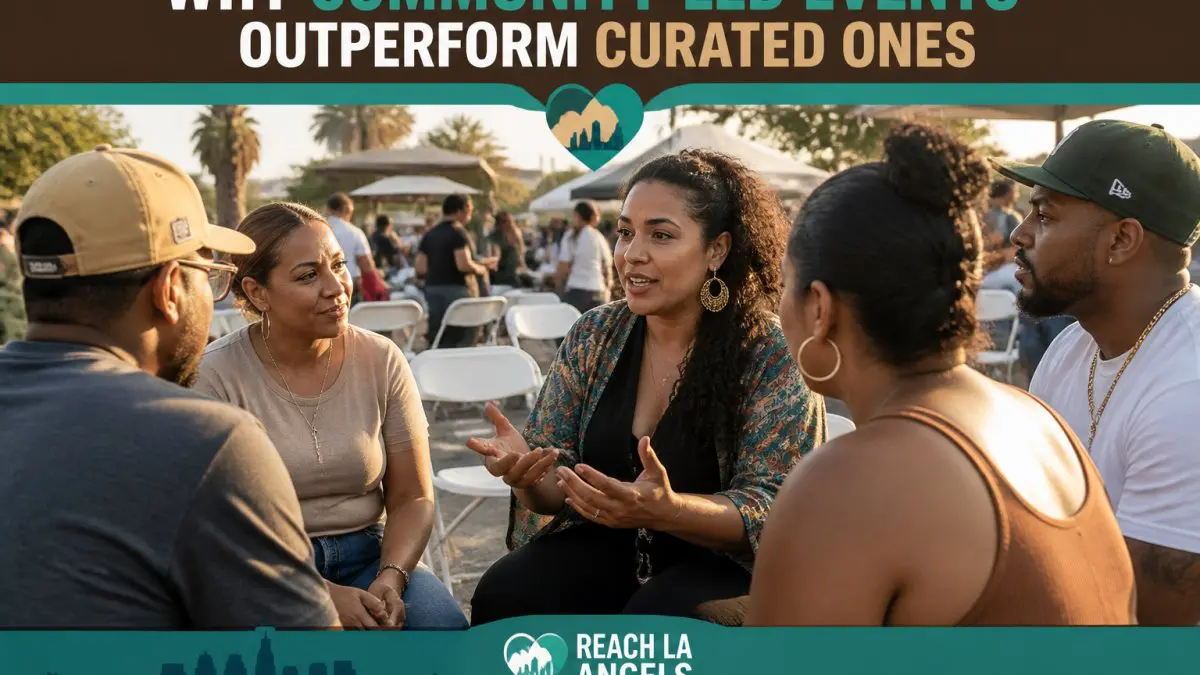
Curated events can look polished and still feel hollow. We’ve seen both. The room knows.
Cultural Event Examples That Get It Right
The best cultural event examples share one trait: the community is on the payroll and in the credits.
- A neighborhood heritage festival where elders co-wrote the program and introduced each performance themselves.
- A block party where local chefs designed the menu and kept the recipe rights.
- An art walk where the exhibiting artists chose the space, the lighting, and the pricing.
- A music night where the lineup was booked by a local promoter from that scene, not an outside talent buyer.
None of this is complicated. It’s just intentional.
Put your community partners on stage at the open, not just in the closing thank-yous. It tells the room who this event belongs to.
Cultural Appropriation in Events: How to Spot and Stop It
Cultural appropriation in events is when an outside organizer takes a community’s traditions for atmosphere or profit without consent, credit, or pay. It’s usually not malicious. It’s usually lazy.
Spot it with three checks:
- Who profits? If the culture is the theme and the community is not paid, that’s a problem.
- Who is credited? If the program never names its sources, ask why.
- Who can say no? If no community partner holds veto power, you have no guardrail.
Stop it early. Rewrite the concept, reallocate the budget, and bring the right people in before the design phase.
The Authenticity Audit: A Step-by-Step Check Before You Announce
Run this audit before your announcement, not after. It takes an afternoon and saves reputations.
Score Your Event Across Five Questions
Answer each question honestly on a 1-5 scale, where 1 is “not at all” and 5 is “fully.”
| Question | What a 5 Looks Like | What a 1 Looks Like |
|---|---|---|
| Did the community help design the program? | Partners co-wrote it | You wrote it alone |
| Are community partners paid? | Line item in the budget | Exposure promised |
| Is every tradition credited by name? | Sources named publicly | Uncredited borrowing |
| Does a partner hold veto power? | Written into the plan | No say at all |
| Did you ask what is off-limits? | Documented consent | Assumed it was fine |
Score 20 or above and you’re in good shape. Below 15, pause the announcement and fix the gaps.
Budgeting, Fair Compensation, and Post-Event Accountability
Money is where authenticity gets tested. A budget line tells the truth about your priorities.
Build the compensation lines before the design lines
Most planners build the program first and look for money to pay people last. Flip it. Put the people lines in the budget before the stage layout, the lighting, or the signage. If the culture is the draw, the community should be funded like the draw.
What belongs in the budget:
- Cultural advisors and reviewers. Paid for their time reviewing the program, the script, and the marketing.
- Performers, speakers, and chefs. Professional rates, plus materials and travel.
- Translators and interpreters. Especially for events with multiple language communities.
- Accessibility. ASL interpreters, captioning, accessible seating, and transit support.
- Community-led programming. Let partners control a real portion of the program and the budget that goes with it.
A common pattern is offering exposure instead of payment. Exposure does not cover a vendor’s rent. If a partner is bringing the culture, they should be on the payroll, not in the thank-you slide.
Measure what you actually delivered
Authenticity is not a vibe you announce. It is something you can check. After the event, look at:
- Community satisfaction. Ask partners directly how it felt to be represented.
- Representation in decision-making. Were community voices in the room when choices were made, or only at the reveal?
- Partner compensation. Did the people who carried the culture get paid, and on time?
- Repeat participation. Did partners want to work with you again?
- Attendee learning. Did the audience leave knowing more about the culture than when they arrived?
None of this requires a research firm. A short survey and a few honest conversations will tell you more than a polished recap deck.
Close the loop after the event
Post-event accountability is rare. That is exactly why it builds trust that lasts.
- Send a short recap to every partner within two weeks.
- Ask what worked and what did not, and listen without defending.
- Publish what you will change next time.
- Report outcomes back to the community, not just to sponsors.
- Keep the relationship going past a single event. The next one starts with the trust you built on the last one.
Authenticity is a budget line and a follow-up call, not a theme. Fund the people who carry the culture, then show them what you did with their input.
Conclusion
Authenticity is a practice, not a vibe, and it starts with who holds the pen. If you’re building a cultural event and want the right audience in the room, Reach LA Angels is where we connect community-driven events with people who show up. Post your event on our platform, and let’s keep the city connected and represented.
Frequently Asked Questions
What does it mean for an event to be culturally authentic?
It means the community the event represents helped shape it, not just attend it. Organizers consulted elders, artists, and local businesses before booking anything. The food, music, and programming come from people inside that culture, and those contributors are paid and credited. Authenticity shows up in decisions, not decor. If you can point to who was consulted, who was compensated, and what changed because of their input, you have a culturally authentic event.
How can event organizers avoid cultural appropriation in events?
Start with a simple rule: nothing about a culture without someone from that culture at the table. Build a consultation process before you lock the venue, the menu, or the lineup. Pay the cultural experts and performers you bring in. Skip sacred symbols, regalia, and rituals that were never meant for public performance. And when someone from the community tells you a choice reads wrong, change it. Cultural sensitivity in event planning is mostly about listening early and adjusting fast.
What are examples of culturally authentic events?
Look for community-led events where the neighborhood runs the show. A Juneteenth block party programmed by local Black organizers and businesses. A Día de los Muertos procession built with families who keep the tradition at home. A Caribbean carnival with mas bands led by Caribbean designers. A Native American powwow organized by tribal members, with dance and drum protocols respected. In each case the culture is represented by the people who live it, and money flows back into that community.
Why should cultural communities help shape an event?
Because they catch what outsiders miss. Community partners flag sacred elements, correct inaccurate history, and steer programming toward what people actually want to see. They also bring the audience. When a neighborhood feels ownership of an event, attendance and word of mouth follow. Organizers who skip that step often end up with a polished production that feels hollow, and the community can tell. Consultation is not a courtesy. It is the difference between a cultural event and a costume.
A challenge for you: your next cultural event will be judged by the community before it’s judged by anyone else. Build it with them, pay them fairly, and credit them loudly. Get started with Reach LA Angels and put your event in front of an audience that values the real thing.