
How to Measure ROI for Community Event Promotion
Table of Contents
- Start With the Event Marketing ROI Formula
- Community Event Marketing Metrics That Actually Matter
- How to Read Social Media Event Analytics
- Use a Post-Event Evaluation Template to Close the Loop
- Measuring ROI When Your Community Event Is Free
- Common Mistakes That Skew Your Community Event ROI
- Frequently Asked Questions
Last Updated: October 17, 2026
Start With the Event Marketing ROI Formula
Most organizers count heads and call it a win. Heads don’t pay the venue. Here’s how to measure ROI for community event promotion the way a seasoned producer does: total revenue minus total cost, divided by total cost, then multiplied by 100. That’s your event marketing ROI formula. It gives you a clean percentage you can defend to a sponsor, a partner, or your own books.
A community event is not a party with a budget. It’s a small business with a short lifespan. Treat the math that way and the decisions get easier.
What Counts as Revenue and What Counts as Cost
Revenue is more than ticket sales. Add sponsor dollars, vendor booth payments, drink and merch sales, and any grants. Cost includes the venue, talent, permits, security, printing, paid ads, and your own hours. Count every line. The costs people forget are the ones that wreck the number.
A common mistake is leaving out staff time. If you spent weeks promoting, that labor is a cost. Track it.
Give every promo channel its own tracking link or discount code. When the money comes in, you can tell exactly which post, flyer, or partner brought that guest. No code, no proof.
Community Event Marketing Metrics That Actually Matter
The metrics that matter are the ones tied to money and repeat attendance: cost per attendee, conversion rate from views to RSVPs, sponsor value delivered, and return rate. Vanity numbers like impressions feel good and prove nothing.
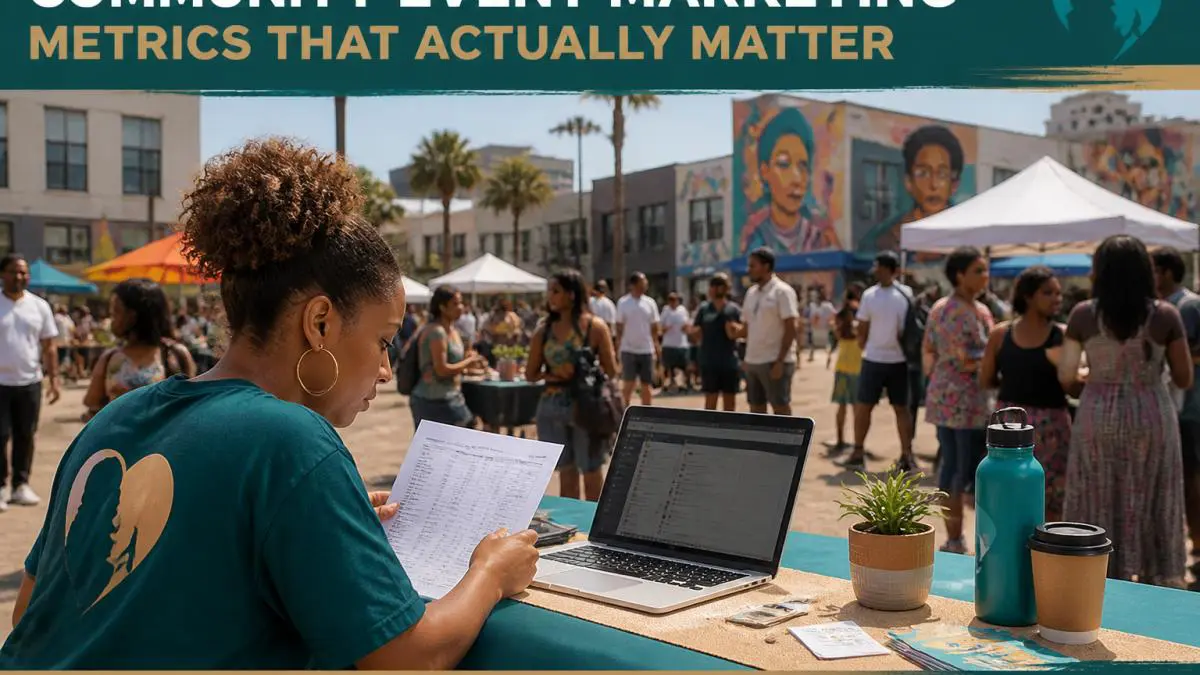
Community event marketing metrics should answer one question: did this promotion earn more than it cost? Build a short list you check every time.
- Cost per attendee: total promo spend divided by actual guests
- View-to-RSVP rate: how many people saw the listing and signed up
- Show rate: RSVPs versus people who actually walked in
- Sponsor impressions and mentions: proof you delivered what you promised
- Return rate: how many guests came back to a second event
Keep the list tight. Five numbers you trust beat twenty you ignore.
How to Read Social Media Event Analytics
Social media event analytics tell you which posts drive real sign-ups, not just likes. Read them by channel and by post, then match each spike to a promo push. A post that pulls comments but no RSVPs is noise.
Start with reach, then saves, shares, and link clicks. Saves and shares signal intent. Clicks close the loop. If a flyer gets shared but the RSVP page stays quiet, your call to action is weak.
Chasing follower counts is the fastest way to skew your ROI. A big following that never shows up is a cost with no return. Judge channels by attendance, not applause.
Use a Post-Event Evaluation Template to Close the Loop
A post-event evaluation template turns a good night into next year’s playbook. Fill it out within 48 hours, while the details are fresh. This is the step most organizers skip, and it’s the one that compounds.
Here’s a simple template you can copy:
- Total revenue (tickets, sponsors, vendors, sales)
- Total cost (venue, talent, permits, security, ads, labor)
- Net profit and ROI percentage
- Attendees vs. RSVPs vs. goal
- Top three promo channels by sign-ups
- Sponsor deliverables met (yes/no, notes)
- Three things to repeat, three to cut
- One quote from a guest or partner
Fill it in, file it, and read it before you plan the next one. That’s how a promotion budget gets sharper each round.
The ROI number is only useful if it changes your next decision. Review the template before you spend a dollar on the next event.
Measuring ROI When Your Community Event Is Free
Free events still have ROI. You just measure value, not ticket revenue. Value can be sponsor exposure, new email sign-ups, vendor sales, donations, or community goodwill you can point to.
Assign a dollar value where you can. A sponsor paid for reach, so track the reach you delivered. Count sign-ups and what they’re worth to you over time. Donations and vendor sales are direct revenue. Add those to the formula and run the same math.
Qualified language helps here: many organizers find that a free event’s real return shows up in the follow-up, not the night itself. Capture contacts, then measure what those contacts do next.
Common Mistakes That Skew Your Community Event ROI
The biggest mistakes are counting free reach as revenue, ignoring staff time, and blaming the wrong channel. Each one throws off the number and the lesson you take from it.
Other traps we see often:
- Mixing personal and event spending
- Forgetting comp tickets in the attendee count
- Measuring likes instead of sign-ups
- Skipping the follow-up, so you never learn the return
Get these right and the math tells the truth. Get them wrong and you’ll make the same costly call twice.
At Reach LA Angels, we’ve watched local creators grow by tracking the right numbers and cutting what doesn’t convert. Our event promotion services put your event in front of an audience already looking for real cultural experiences, so your promo spend lands on people who show up.
Frequently Asked Questions
How do you calculate ROI for event promotion?
Take the revenue your event generated, subtract every promotion and production cost, then divide that net figure by total cost and multiply by 100. If a community event brought in $8,000 and cost $5,000 to promote and produce, your ROI is 60%. Count ticket sales, vendor fees, sponsorships, and any measurable post-event sales. Count ad spend, flyers, paid listings, staff time, and venue costs. Keep the formula consistent event to event so your community event ROI numbers stay comparable.
What metrics should you track for community event marketing?
Track reach, engagement, click-throughs, RSVPs, actual attendance, cost per attendee, and revenue per attendee. Add follower growth and email signups if you promote through social and newsletters. The community event marketing metrics that matter most are the ones tied to attendance and dollars, not vanity numbers. A post with 50,000 impressions and 12 RSVPs tells you less than a targeted post with 3,000 impressions and 80 RSVPs. Match every metric to a decision you can act on.
How do you measure event promotion when attendance is free?
Assign a dollar value to what a free attendee is worth to you: future ticket sales, vendor revenue, email signups, or sponsor exposure. Then measure cost per attendee and compare it to that value. Also track engagement depth: how many people stayed past the first hour, signed up for your list, or followed your page. Use a post-event evaluation template to record these numbers while they are fresh, and review social media event analytics to see which posts drove the most actual check-ins.
How can you track which social media posts drive event attendance?
Use unique links or promo codes for each platform and post, then compare redemption at the door. Check social media event analytics for saves, shares, and profile visits in the 72 hours before the event, since those often precede attendance. Ask one question at check-in: where did you hear about us? Log the answers. Over two or three events, patterns show which platforms and post styles actually fill the room, and you can shift budget toward what works.
Every organizer faces the same wall: you can’t prove ROI if you can’t see who actually found you. Reach LA Angels closes that gap with curated listings, a platform built for local creators, and a community that values authentic events. Post your event, track the sign-ups, and let the numbers speak for you. Post Your Event and start measuring what matters.