
Is Eventbrite Worth It for Small Neighborhood Festivals?
Table of Contents
- What Eventbrite Actually Does for a Small Festival
- Breaking Down the Fees on a Small Budget
- How to Create an Eventbrite Event Page That Converts
- Eventbrite Alternatives for Community Events
- How to Promote a Neighborhood Festival Beyond the Ticketing Marketplace
- Local Festival Marketing Checklist
- Deciding Whether Eventbrite Fits Your Festival’s Size and Goals
- Frequently Asked Questions
Is Eventbrite worth it for small neighborhood festivals? For most small, free or donation-based events, the honest answer is: it depends on what you’re trying to get out of it. Eventbrite is a solid ticketing engine. It is not, by itself, a promotion plan. The organizers who struggle are usually the ones who assumed a listing would do the work for them. At Reach LA Angels, we look at this question from the ground up, because a neighborhood festival lives or dies on attendance and community buy-in, not on the checkout page.
What Eventbrite Actually Does for a Small Festival
Eventbrite is a ticketing and event listing platform. It handles event pages, registration, ticket sales, payment processing, and attendee check-in. For a festival that charges admission, that’s useful. You get a clean page, a way to take money, and a list of who’s coming.
What it does not do is fill your block. A listing on a large marketplace competes with concerts, comedy shows, and corporate mixers for the same attention. Your festival, with its local vendors and neighborhood character, can get lost there. Treat Eventbrite as your checkout counter, not your storefront.
Breaking Down the Fees on a Small Budget
Fees are where small organizers get surprised. So let’s not be vague about it. Eventbrite’s pricing has two moving parts: a per-ticket service fee and payment processing. You can pass those to the buyer or absorb them, and that single choice changes your whole budget.
Here’s how to think about it without guessing.
The three cost buckets
- Per-ticket service fee: a platform fee charged per paid ticket. This is the platform’s cut.
- Payment processing: a per-transaction charge levied by the payment processor. This is separate from the platform fee.
- Optional add-ons: paid plans, promoted listings, and reader/scanning tools. Skip these unless your event truly needs them.
Free events
If you charge nothing for tickets, you generally pay nothing to the platform for free registration. That makes Eventbrite a reasonable headcount tool for a free block party. You still want a registration page so you know how many people to expect for food, supplies, and capacity.
Paid events: run the sample math
Take a low-priced ticket. The per-ticket fee and processing fee each take a bite, and the flat per-ticket amount hurts most on cheap tickets. On a small sale count, that flat fee is the killer, not the percentage. Low-priced tickets carry a disproportionate share of fixed per-ticket costs.
So do this before you set a price:
- Pick your ticket price.
- Add the per-ticket fee and the processing fee using the current published rates.
- Decide who pays: buyer or you.
- Multiply by realistic tickets sold, not your dream number.
- Subtract from gross revenue, then subtract vendor fees, permits, insurance, and sound.
If the remainder doesn’t cover your fixed costs, the ticket price is too low or the platform cost is too high for your model.
Passing fees to the buyer
You can shift fees to the buyer at checkout. It protects your margin, but it raises the sticker price your neighbors see. For a community festival, a visible fee bump can cool walk-up interest. Test it. Some organizers absorb fees on low-priced tiers and pass them on higher tiers.
Donations and mixed ticket types
If your festival is free entry with suggested donations, or has free general admission plus a paid VIP or add-on, model each type separately. Free tiers cost you nothing to process. Paid add-ons carry the per-ticket cost.
Build a one-page break-even sheet before you pick a platform. List expected attendance, ticket price, per-ticket fee, processing fee, and fixed costs. If the sheet doesn’t balance, no platform will save you.
What to watch
- Flat per-ticket fees punish low-priced tickets.
- Processing fees apply per transaction, so bundled or multi-ticket purchases can reduce the per-head cost.
- Paid plans only make sense if you sell enough tickets to offset the subscription.
- Promoted listings are a marketing spend, not a ticketing cost. Budget them separately.
Run the numbers first. Then decide if the convenience is worth the fee.
Here are the three cost buckets at a glance, so you can see where the money goes before you set a price.
| Cost bucket | What it is | Note |
|---|---|---|
| Per-ticket service fee | The platform’s cut on each paid ticket | Charged per paid ticket |
| Payment processing | Per-transaction charge from the payment processor | Separate from the platform fee |
| Optional add-ons | Paid plans, promoted listings, scanning tools | Skip unless the event truly needs them |
How to Create an Eventbrite Event Page That Converts
A page that converts answers three questions fast: what is it, where is it, and why should I show up. Lead with a clear title and a strong first image. Put the date, time, and address above the fold. Describe the vibe in plain language, the way you’d tell a friend.
Add a short list of what’s happening: performers, food, activities, kid zones. Make it easy for people to share the link. And keep your description honest. Overpromising a crowd you can’t deliver turns into bad reviews fast.
Eventbrite Alternatives for Community Events
If Eventbrite’s fees or audience don’t fit your festival, you have options. Some organizers use a free registration tool for headcount and collect donations directly. Others sell through their own website with a simple payment link. For community-centered, culturally specific events, a niche platform can reach the audience that already wants to show up.
Reach LA Angels is built for exactly that: curated listings that spotlight community-driven events in Los Angeles, with an emphasis on uplifting Black and Brown communities. If you want to see how it stacks up against a generalist marketplace, read Eventbrite vs Reach LA Angels for Niche Cultural Events. For a wider look at platforms beyond Eventbrite that suit cultural and community events, see Black Cultural Events: Platforms Beyond Eventbrite.
How to Promote a Neighborhood Festival Beyond the Ticketing Marketplace
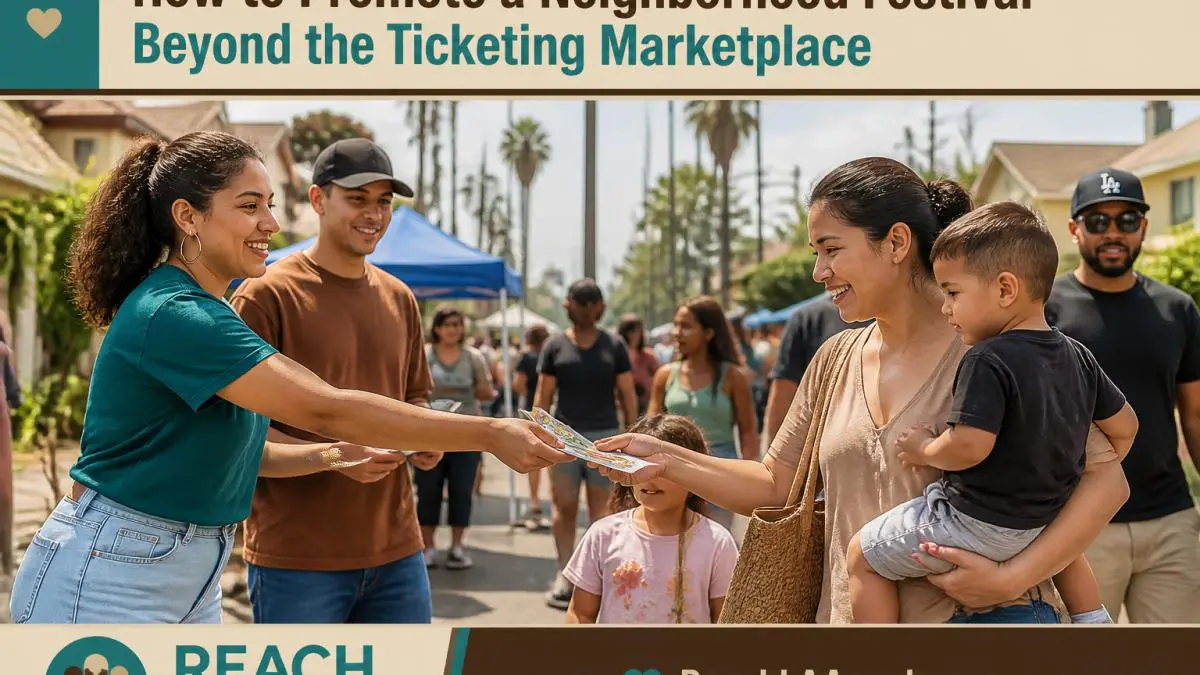
Here’s the part most guides skip. A neighborhood festival gets its crowd from the block itself: churches, barbershops, local businesses, school newsletters, and the people who walk by with their kids. A listing helps people who already search for events. Your neighbors are the ones who actually need a nudge.
Start with flyers at high-traffic spots, partner with local businesses to host a table, and post in neighborhood groups. Build a simple promotion calendar so you’re not scrambling in the last week. For a closer look at tools that help you schedule across channels, see Social Media Management Tools vs Event Platforms (2026). Then ask yourself whether paid promotion pays off for your event; Is Niche Event Promotion Worth the Investment walks through that math. If you’d rather hand off the heavy lifting, Event Promotion Services can put your festival in front of the crowd you’re after, and our Advertising Services cover the paid side.
Local Festival Marketing Checklist
Use this as a working list, not a theory:
- Confirm your date against other local events so you don’t collide
- Set a total budget and a per-ticket break-even number
- Choose your ticketing method and check its current fees
- Post the event page at least six weeks before the date
- Print flyers and place them where your neighbors already gather
- Recruit volunteers early; a steady volunteer crew is what keeps a festival running smoothly
- Share the event with local businesses and ask them to post it
- Plan a clear check-in or headcount method on the day
- Send a reminder to everyone who registered 48 hours out
Volunteers deserve their own plan. If you need a process for bringing in helpers, 7 Steps to Recruit Volunteers for Local Events gives you a practical sequence to follow.
Deciding Whether Eventbrite Fits Your Festival’s Size and Goals
Most guides stop at ‘it depends.’ Let’s give you a framework you can actually use. Answer four questions and the decision usually makes itself.
1. Are you charging admission?
If yes, a ticketing platform earns its fees because it handles payment, receipts, and check-in. If your event is free or donation-based, the platform’s value drops fast. You mostly need a headcount page, and a free registration tool or a simple form does that job.
2. How many people do you realistically expect?
Be honest, not hopeful. A common pattern:
- Under a few hundred, mostly neighbors: flyers, community groups, and word of mouth do more than a marketplace listing.
- A few hundred to about a thousand, some from outside your network: a ticketing platform starts to pay off for payment and check-in.
- Over a thousand, wider draw: platform tools, scanning, and reporting become worth the cost.
3. Is ticket revenue essential or a bonus?
If ticket money funds the festival, protect your margin and model fees carefully. If tickets are a bonus on top of sponsors and vendors, convenience matters more than squeezing every dollar.
4. Do you need data and check-in?
If you need attendee lists, exportable data, and fast check-in at the gate, a platform saves you labor. If you just need a rough headcount, you don’t need the machinery.
The break-even check
Before you commit, run this simple test:
- Total fixed costs: permits, insurance, sound, vendors, supplies.
- Expected paid tickets times net revenue per ticket after fees.
- If net ticket revenue covers fixed costs, the platform cost is justified.
- If it doesn’t, either raise the price, cut costs, or drop to a free/low-cost registration model.
If your festival is free or donation-based and your crowd is local, put your effort into flyers, partnerships, and word of mouth. If you’re selling tickets to a wider crowd and need payment plus check-in, a ticketing platform earns its fees.
A quick decision tree
- Free entry, local crowd, headcount only: use a free registration tool.
- Free entry with donations: free registration plus a direct donation link.
- Paid entry, small crowd, simple needs: a low-cost ticketing option or your own site with a payment link.
- Paid entry, larger crowd, need check-in and reporting: a full ticketing platform.
- Mixed free and paid tiers: model each tier separately before choosing.
What tips the scale toward Eventbrite
You charge admission, expect a crowd beyond your immediate network, and want built-in payment, check-in, and reporting. That’s the sweet spot.
What tips it away
Free or donation-based, hyper-local, and your real goal is community presence rather than ticket revenue. In that case, your effort is better spent on the block itself.
Eventbrite can work for a small festival. It just won’t do the promotion for you. Plan the crowd first, run the break-even, then pick the tool.
Frequently Asked Questions
Is Eventbrite worth it for a small community festival?
It depends on whether you charge for entry. If your festival is free or relies on donations, Eventbrite’s ticket fees can be hard to justify, since you may pay for a service you don’t need. If you are selling paid tickets and want a checkout system that handles payments and attendee lists, it can save you time at the door. Run the numbers on your expected sales against the fee structure before you commit, and factor in how much local reach you actually get from the platform.
Can you use Eventbrite for free community events?
Yes. Eventbrite allows free event listings, and many organizers use it to collect RSVPs and track headcount. The tradeoff is that free events on the platform still carry their own setup work, and the discovery you get is broad rather than local. For a neighborhood festival, pair any free listing with direct promotion through community groups, local businesses, and social channels so people in your area actually see it.
What should a small festival include on its event page?
Lead with the date, time, and exact location, then describe what people will experience in plain language. List vendors, performers, and activities so attendees know what to expect. State whether entry is free, paid, or donation-based, and explain any accessibility details, parking options, and rain plans. Add a clear contact method. A focused page that answers the basic questions up front outperforms a long one that buries the details.
How do small festivals promote events without relying only on ticketing platforms?
Start with the people already in your community. Reach out to neighborhood associations, local shops, churches, schools, and community organizations and ask them to share your event. Put flyers where your neighbors already gather. Use Instagram and local Facebook groups with event-specific posts, and invite local creators and artists to share the lineup. A ticketing listing is one piece of promotion, not the whole plan.
