
How to Build Community Through Local Events
Table of Contents
- Why Local Events Build Community That Lasts
- Your Community Event Planning Checklist
- How to Promote Local Events Effectively
- Designing the Event Experience to Build Community
- Best Practices for Inclusive Community Gatherings
- Keep the Momentum Going After the Event
- Measure What Matters: Community Impact Metrics
- Conclusion: Start Small, Stay Consistent
- Frequently Asked Questions
Last Updated: September 9, 2026
Why Local Events Build Community That Lasts
Community building is the deliberate practice of fostering mutual care, shared identity, and repeated connection among people who share a place or purpose. Local events remain one of the most reliable engines for this work because they convert passive proximity into active relationship. When neighbors break bread, dance to the same music, or cheer for the same local team, they create what sociologists call social capital, the trust and reciprocity that makes neighborhoods resilient. Local events can do more for neighborhood connection than a year of online commenting ever could.
The key insight most planners miss is that the event itself is not the product. The relationships formed are. A single gathering that sparks three ongoing friendships or one new volunteer partnership outperforms a larger event that everyone attends alone. This is why the strategy matters more than the spectacle. Below, we’ll walk through the full lifecycle, from the initial planning checklist to the metrics that tell you whether your efforts actually strengthened the community.
Your Community Event Planning Checklist
Starting with a clear plan separates events that build lasting bonds from those that merely consume a Saturday afternoon. A community event planning checklist keeps you grounded when logistics get chaotic. Begin with a core team of three to five committed organizers, then lock down the essentials before promoting anything.
- Define the purpose: Is this about celebration, problem-solving, or cultural connection? Write one sentence and keep it visible.
- Secure the space: Confirm permits, insurance, and public space use rules with your city or venue well in advance.
- Set a realistic budget: List must-haves versus nice-to-haves. Crowdfunding and sponsorship acquisition can fill gaps, but start with what you can guarantee.
- Recruit volunteers: Assign roles for setup, greeting, activities, and cleanup. Volunteer coordination is often the difference between a smooth event and a stressful one.
- Build a rain plan: Have an indoor backup or a clear cancellation date.
Community event planning works best when you share ownership early. Recruit community stakeholders to co-host or advise, which spreads the workload and deepens buy-in across different networks.
How to Promote Local Events Effectively
Promoting local events effectively requires a deliberate, multi-channel sequence that starts weeks before the date and continues through the day itself. A common mistake is treating promotion as a single announcement rather than a sustained campaign. The most successful local outreach combines digital event promotion with grassroots organizing, and it uses each channel to feed the others.
Build a Promotional Timeline
Work backward from your event date. Eight weeks out, confirm your core partners and create a shared promotional toolkit they can use. Six weeks out, launch your event page and begin posting to neighborhood-specific channels. Four weeks out, start the in-person push with flyers and word-of-mouth. Two weeks out, shift to urgency-based messaging. The final 48 hours should be reserved for direct reminders to anyone who RSVP’d.
Layer Your Digital Channels
A dedicated event page on a platform is your hub, but it is not enough. Post in local Facebook groups, Nextdoor, and neighborhood subreddits, tailoring the message to each audience. Use local hashtags on Instagram and tag local businesses and organizations. If your community uses a messaging app like WhatsApp or Slack, ask a trusted member to share the event there, as these channels often have higher engagement than public feeds.
Turn Partners into Promoters
Partnerships are not just for funding; they are your most credible promotional channel. Meet with each partner organization in person or by phone, and give them clear, ready-to-share assets: a short description, a graphic, and a link. Ask them to post twice, once two weeks out and once the day before. Offer to cross-promote their work at your event in return. This reciprocity is the foundation of local partnership marketing.
Close the Loop Between Online and In-Person
This is the step most guides miss: use your online community to sustain the momentum your event generates. Create a dedicated hashtag for the event and encourage attendees to use it. Before the event, post a question asking what neighbors hope to experience. After the event, share photos and tag attendees. This turns a one-day gathering into an ongoing conversation that lives in the digital spaces where your community already connects. The event becomes a touchpoint in a continuous cycle, not an isolated moment.
Track your promotion by source. Ask attendees how they heard about the event, either at check-in or in a post-event survey. This tells you which channels deserve your energy next time and which are not worth the effort.
In-person promotion still matters enormously. Post flyers at local businesses, libraries, and community centers. Send volunteers to other neighborhood events to talk about yours. According to guidance from the National Recreation and Park Association, partnerships with existing community institutions are among the most effective ways to reach residents who might not see digital ads. The key is to treat every channel as part of one system, not as isolated tactics.
Designing the Event Experience to Build Community
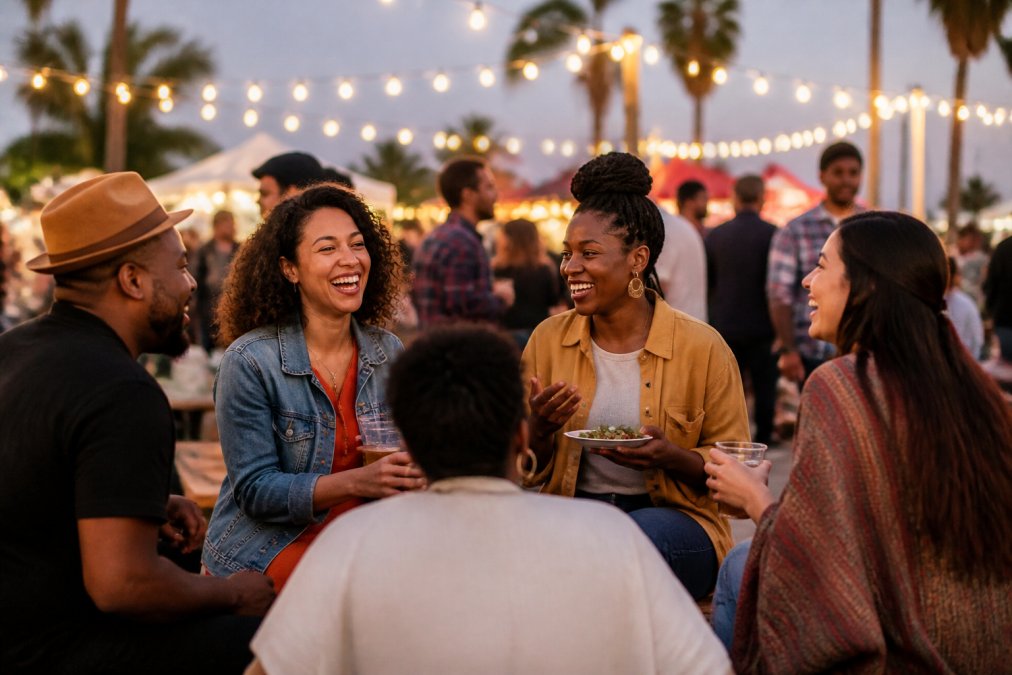
The structure of your event determines whether people actually mingle or just occupy the same space. Designing the event experience to build community means engineering moments of interaction rather than hoping they occur naturally. Passive formats, like a lecture or a stage performance, create audience members, not connections.
Incorporate activities that require cooperation or conversation. A community mural where strangers paint side by side, a group cooking demo, or a simple icebreaker game all lower the barrier to conversation. Food is the great equalizer; family-style seating or shared tables forces interaction in a way that individual chairs never will.
Consider the arc of the event. Start with a low-pressure welcome, build to a shared moment like a toast or a group photo, and end with an invitation to continue the conversation. The community development resources from the Knight Foundation emphasize that successful gatherings create a sense of shared ownership, where attendees feel they contributed to the experience rather than just consuming it. That feeling of contribution is what brings them back.
Best Practices for Inclusive Community Gatherings
Inclusive community gatherings are not just welcoming in theory; they are accessible in practice. Best practices for inclusive community gatherings start with asking who is missing and why. If your event is not reaching the full diversity of your neighborhood, the barrier is usually logistical rather than cultural.
- Language access: Provide materials and announcements in the primary languages spoken in your community.
- Physical accessibility: Choose venues with step-free access and ensure pathways are wide enough for wheelchairs and strollers.
- Sensory considerations: Offer a quiet space for those who need a break from noise and crowds.
- Cost barriers: Keep the event free or low-cost, and ensure food options accommodate common dietary restrictions.
- Timing: Schedule around work shifts, religious observances, and school calendars.
Inclusive programming also means sharing the microphone. Invite local artists, faith leaders, and small business owners to co-lead segments rather than just attend. This distributes visibility and reinforces that the event belongs to the whole community, not just the organizing committee. Reach LA Angels prioritizes this principle by spotlighting events that uplift Black and Brown communities, ensuring that cultural heritage is honored rather than appropriated or overlooked.
Keep the Momentum Going After the Event
The event ends, but the community building should not. Post-event retention is where most organizers drop the ball, yet it is the highest-use phase for long-term social cohesion. The energy you cultivated will dissipate within weeks unless you channel it into ongoing structures. But before you can retain attendees, you need to ensure your event is legally and safely grounded, because the risk of liability is a major barrier that stops many would-be organizers before they even start.
Understand Your Legal and Safety Obligations
Hosting a public gathering carries real responsibilities. At minimum, you need to understand the rules for public space use in your city, which typically require a permit. Permit requirements vary, but they often involve proof of insurance, a site plan, and sometimes a noise waiver. Contact your city’s parks and recreation department or events office early, as permits can take 30 to 60 days to process.
Insurance is another critical piece. Many venues require organizers to carry general liability insurance, which protects against claims of property damage or bodily injury. Policies for a single community event can cost a few hundred dollars, depending on the size and risk profile. If you are partnering with a local government agency or a nonprofit, they may be able to add you to their policy, which is often the most cost-effective route.
Food service adds another layer. If you are serving food, check your state and local health department rules. Some jurisdictions require a temporary food service permit, especially if food is prepared on site. If you are inviting food vendors, confirm they have their own permits and insurance. Alcohol is a separate and higher-risk category; serving alcohol at a public event typically requires a special permit and may require you to use a licensed caterer or bartender who carries liquor liability coverage.
Create a Simple Safety Plan
A basic safety plan does not need to be elaborate, but it should be written down. Identify a first-aid station, designate a point person for emergencies, and ensure at least one volunteer is trained in CPR. Walk the venue beforehand to spot hazards like uneven pavement or low-hanging branches. Have a clear plan for severe weather, including a cancellation decision point. Communicate this plan to your volunteers before the event starts.
Turn Attendees into Long-Term Members
Once the legal and safety foundations are in place, focus on retention. Within 48 hours, send a thank-you message to every attendee and volunteer. Include a photo gallery and a short survey asking what they loved and what they would change. Event feedback is gold, but only if you act on it publicly. Share what you learned and how the next gathering will improve.
Create a simple pathway for continued involvement. Start a neighborhood group chat, announce a recurring monthly meetup, or invite attendees to join the planning committee for the next event. The goal is to convert one-time attendees into repeat participants and eventually into co-hosts. This gradual escalation from guest to volunteer to organizer is the true measure of community development.
Do not skip the permit or insurance process to save time. A single incident without coverage can create personal liability that outweighs any benefit the event provided. The paperwork is part of the community building work.
The most successful community building is cyclical: gather, connect, reflect, and gather again with new voices at the table. And it is built on a foundation of responsible planning that protects both your attendees and your organization.
Measure What Matters: Community Impact Metrics
Tracking attendance is easy, but it tells you little about whether you actually built community. Measuring social impact metrics requires looking at the quality and durability of the connections you enabled. Community impact is visible in repeat participation, new collaborations, and increased resident initiative.
Start with a simple feedback mechanism. Ask attendees whether they met someone new they plan to see again, and whether they feel more connected to their neighborhood. Track returning attendees across multiple events; a high repeat rate signals genuine community building, while a high one-time rate suggests you are drawing a crowd without creating belonging.
Look for second-order effects. Did two attendees start a mutual aid group? Did a local business volunteer to sponsor the next event? Did attendance at neighborhood association meetings rise? These indicators of social capital are harder to quantify but far more meaningful. The U.S. Census Bureau community resilience data offers frameworks for understanding how local social connections contribute to neighborhood stability over time.
Do not confuse social media reach with community engagement. A thousand likes on a post can coexist with an empty room. Measure the depth of live interaction, not the breadth of digital impressions.
Conclusion: Start Small, Stay Consistent
Building community through local events is not about one spectacular festival. It is about the rhythm of showing up, month after month, with genuine intention. Start with a small gathering that you can execute well, learn from the feedback, and grow from there. Consistency builds trust faster than scale ever will.
The work of community building is ongoing, and you do not have to do it alone. Platforms like Reach LA Angels exist to connect local organizers with audiences who are actively seeking authentic cultural experiences, increasing visibility for events that strengthen neighborhood connection across Los Angeles. Whether you are planning a block party, a cultural showcase, or a community forum, the principles remain the same: design for interaction, include intentionally, and measure what truly matters.
Post your event with Reach LA Angels and give your community gathering the visibility it deserves.
Frequently Asked Questions
What are the best ways to promote community events?
The best promotion combines online and offline channels. Start with a dedicated event page on a platform like Reach LA Angels, then share it across neighborhood social media groups and with local influencers. Print flyers for community boards, libraries, and local shops. Partner with nearby businesses, faith groups, and schools to spread the word. Email newsletters to past attendees work well too. The key is consistency: post updates weekly leading up to the event, not just once.
How do you measure the success of a community event?
Look beyond attendance numbers. Track how many first-time attendees came, how many returned from a previous event, and how many signed up for your email list. Collect feedback through quick surveys or comment cards. Watch social media mentions and tags during and after the event. The strongest signal of community building is what happens afterward: do people stay connected, attend future events, or volunteer to help organize the next one?
How can local events support Black and Brown-owned businesses?
Give local Black and Brown-owned businesses visible roles beyond just being vendors. Invite them to sponsor activity stations, host demonstrations, or speak about their work. Feature their stories in your event marketing. Pay them fairly for their participation, not just in exposure. After the event, share a directory of participating businesses with attendees. This creates economic opportunity while strengthening the cultural authenticity that makes community events meaningful.
How do you ensure community events are inclusive and accessible?
Start by choosing a venue with wheelchair access, accessible restrooms, and nearby public transit. Schedule events at times that work for families and shift workers. Provide materials in multiple languages if your community needs them. Offer quiet spaces for neurodivergent attendees. Keep ticket costs low or free, with a suggested donation option. Ask community members with disabilities to review your plans before you finalize them. Inclusion starts in the planning phase, not on event day.