
How Do Black-Owned Businesses Build Marketing Strategy in LA?
Last Updated: October 24, 2026
Quick Summary
Marketing strategies black-owned businesses need in LA start with clarity about who you are, who you serve, and what makes you different. Build from there with intentional campaigns across one primary channel, track five core numbers, and show up authentically to your community.
- Claim and complete your Google Business Profile with neighborhood details and ask satisfied customers for reviews.
- Pick one social platform where your audience spends the most time and post consistently on a schedule you can keep.
- Set one primary goal per quarter with a number and date, then track reach, list growth, conversion, cost per result, and retention.
- Partner with complementary Black-owned businesses and nonprofits to cross-promote and introduce your business to new audiences.
- Create useful content that answers real customer questions, not promotional content that only sells.
Table of Contents
- Why Marketing Strategy Matters for Black-Owned Businesses
- Building Your Brand Identity and Market Positioning
- Local Marketing for Small Businesses: Know Your Niche
- Black-Owned Business Social Media Marketing That Actually Works
- Event Marketing for Small Businesses: Community as Strategy
- Building Your Small Business Marketing Plan with Measurable Goals
- Getting Your Business Visible: Content, PR, and Partnerships
- Start Your Marketing Journey with Reach LA Angels
- Frequently Asked Questions
Why Marketing Strategy Matters for Black-Owned Businesses
Marketing strategies black-owned businesses rely on isn’t optional, it’s survival. In LA, where competition is fierce and attention spans are shorter than ever, a clear strategy separates the businesses that thrive from the ones that fade.
Here’s the reality. A Black-owned business without a deliberate marketing strategy is essentially hoping someone discovers you by accident. That doesn’t happen often. What does happen is that your competitors, the ones with a plan, capture your audience first.
The good news? Building effective marketing strategies black-owned businesses need doesn’t require a massive budget or years of experience. It requires clarity, consistency, and a willingness to show up authentically.
Building Your Brand Identity and Market Positioning
Your brand identity is how the world recognizes you. It’s not just a logo or a color scheme, it’s the feeling people get when they interact with your business.
Start by defining what makes your business different. Not different in a generic way. Different in a way that matters to the people you serve. Maybe you source ingredients from Black-owned suppliers.
Market positioning means claiming a clear space in your audience’s mind. You’re not trying to be everything to everyone. You’re being the best thing to someone specific.
Write down three things: What problem do you solve? Who has that problem? Why are you the best person to solve it? Your answers become the foundation of every marketing decision you make moving forward.
Local Marketing for Small Businesses: Know Your Niche
Small businesses don’t compete on budget. They compete on focus.
LA is massive. Trying to market to all of LA is a losing strategy. Instead, identify your neighborhood or community. Are you serving the Black community in South LA?
Once you’ve identified your niche, become the expert for that community. Show up at their events. Sponsor local organizations. Partner with other Black-owned businesses in that area.
Local marketing for small businesses also means using tools that reach people where they actually are.
Research your niche audience. What problems do they have? What do they value? What media do they consume? What events do they attend?
Black-Owned Business Social Media Marketing That Actually Works
Social media is where your community lives. Social media marketing that actually moves the needle is intentional, consistent, and built around community conversation. Learn how to reach and connect with the culturally conscious audiences that matter to your LA business.
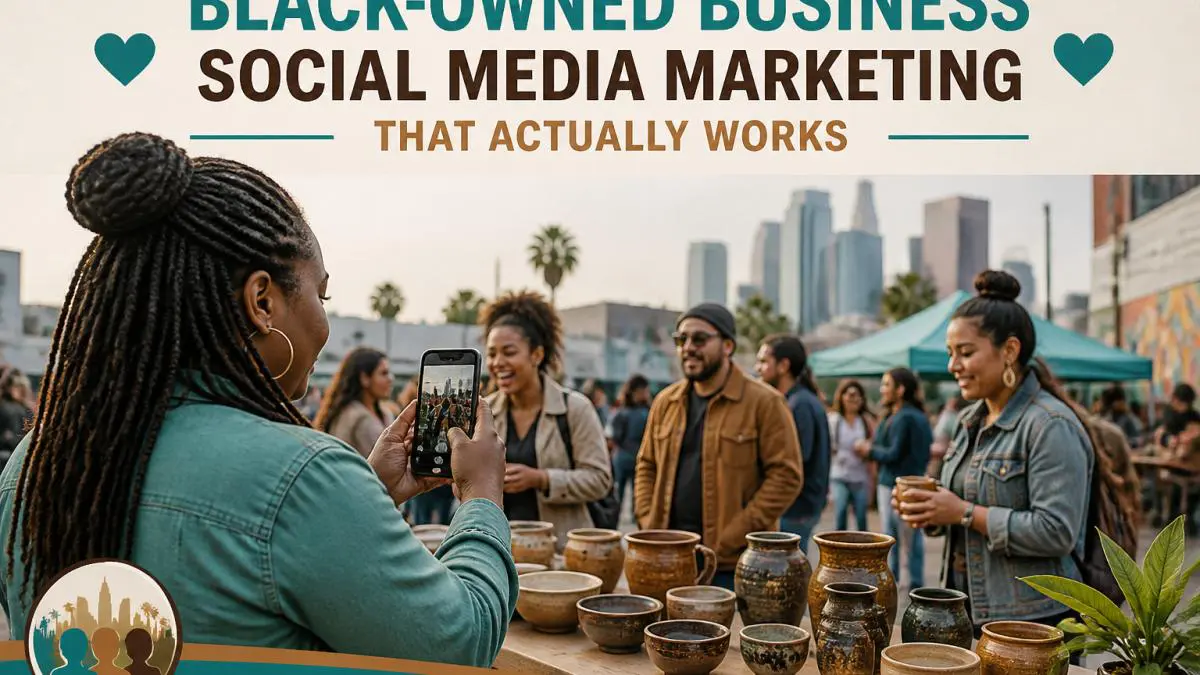
Start with one platform. Most businesses try to be everywhere, Instagram, TikTok, Facebook, Twitter, and end up with weak presence on all of them.
Post consistently. Not every day if that’s not sustainable, but on a schedule you can actually keep. Your audience needs to know when to expect you.
Show your community, not just your product. People follow people, not billboards. Share behind-the-scenes content. Show your team. Tell stories about why you started this business.
Engagement is more important than followers. A post with 50 genuine comments from your target audience is worth more than 500 likes from random accounts. Respond to comments.
Consider how Explore LA & Surrounding Areas can deepen your understanding of the neighborhoods and communities you’re trying to reach on social platforms, helping you speak authentically to the specific audiences in your area.
Event Marketing for Small Businesses: Community as Strategy
If you’re running events or promoting them, understand this: your event is not just a transaction. It’s a gathering. It’s a moment where your community comes together.
Start by building your base audience before you even announce the event. Understand how to build community loyalty and following through events, not just one-time attendance.
When you do promote the event, be specific about what people will experience.
Partner with other businesses and organizations in your community. Cross-promote.
Use word-of-mouth strategically. Ask your attendees to invite friends.
Building Your Small Business Marketing Plan with Measurable Goals
A marketing strategy without a scoreboard is just activity.
Start with one primary goal. Not five. One.
Then build your scoreboard. You don’t need expensive software. A spreadsheet with five columns, date, channel, spend, result, notes, will tell you more than any dashboard you don’t check. Track these core numbers:
- Reach and engagement: how many people saw you, and how many acted (saves, shares, comments, clicks).
- List growth: new email or text subscribers per week, and how many came from each channel.
- Conversion: inquiries, RSVPs, ticket sales, or bookings per channel.
- Cost per result: what you spent to get each inquiry or attendee. This is the number that tells you which channel is actually working.
- Retention: how many customers or attendees come back. Repeat business is the cheapest marketing you’ll ever do.
Map each channel to one number. Instagram and TikTok drive reach and saves. Email drives attendance and repeat business.
Run a weekly 15-minute review. Look at last week’s numbers against this week’s. Note what moved and what didn’t.
Run a monthly check-in and a quarterly reset. Monthly, ask: are we on pace for the quarterly target?
Set a realistic budget band before you spend a dollar.
One goal, five numbers, a weekly 15-minute review, a quarterly reset. That’s the whole system. If you can’t explain your plan on one page, it’s too complicated to run.
A marketing plan you can measure is a marketing plan you can defend, to yourself, to a partner, to anyone who asks what you’re doing with the money.
Track these five core numbers to know which channels actually work.
| Metric | What It Measures | Why It Matters |
|---|---|---|
| Reach and engagement | How many people saw you, how many acted | Shows if content resonates |
| List growth | New email or text subscribers per week | Builds owned audience |
| Conversion | Inquiries, RSVPs, ticket sales, bookings | Tracks actual business results |
| Cost per result | What you spent to get each inquiry or attendee | Reveals which channel earns its keep |
| Retention | How many customers or attendees come back | Repeat business is cheapest marketing |
Getting Your Business Visible: Content, PR, and Partnerships
Visibility is built through four channels working together: local search, content, PR, and partnerships. Most owners skip the first one, and it’s the one that brings in customers who are already looking for you.
Local search first. Claim and complete your Google Business Profile. Fill in every field: hours, service area, categories, photos, and a description that names what you do and who you serve.
Content second. Create things your audience actually wants to consume. Not promotional content, useful content. Answer the questions customers ask you before they ask.
PR third. Local journalists, bloggers, and podcasters are always looking for good stories. According to research on local media outreach, journalists respond better to personalized pitches that explain why their specific audience cares about your story.
Partnerships fourth. Partner with complementary businesses, nonprofits aligned with your mission, and creators in your community who genuinely believe in what you’re doing. Discover proven tactics for increasing visibility of your business within multicultural LA neighborhoods.
Consider hosting or sponsoring community events, speaking at local panels, or collaborating on content with other creators. The goal is to be visible as someone who cares about the community, not just as someone trying to sell something. Advertising Services can amplify these efforts when you’re ready to reach beyond your immediate network.
Do a 10-minute visibility audit once a month. Search your business name and your category plus your neighborhood. If you don’t show up, that’s your next task.
Start Your Marketing Journey with Reach LA Angels
Building marketing strategies for Black-owned businesses takes intention, but it doesn’t have to be complicated. Start with clarity about who you are, who you serve, and what makes you different.
At Reach LA Angels, we understand the unique challenges Black-owned businesses face in LA’s crowded marketplace. Connect directly with Reach LA Angels, the resource built to support creators like you.
When you’re ready to take your business to the next level, we’re here to help.
The businesses that win in LA aren’t the ones with the biggest budgets.
Frequently Asked Questions
What are the most effective marketing strategies for Black-owned businesses?
Effective marketing strategies for Black-owned businesses combine authentic brand positioning, community trust-building, and measurable tactics. Start by defining your niche audience and what makes your business culturally distinct. Use social media to share your story, engage directly with community members, and build customer loyalty through genuine connection. Track what works, website visits, engagement rates, customer referrals, so you can invest in the channels actually reaching your audience.
How can a Black-owned business attract more local customers?
Local marketing for small businesses starts with being visible where your community gathers. Optimize your Google Business Profile so people find you in local searches. Partner with other local creators and businesses for cross-promotion. Host or sponsor community events. Share content about your business’s values and connection to the neighborhood. Build customer loyalty by recognizing repeat customers and asking for referrals, word of mouth is powerful in tight-knit communities.
What social media platforms work best for small local businesses?
Instagram and TikTok can be highly effective for visual storytelling and reaching younger audiences. Facebook still drives strong engagement with established community members and older demographics. LinkedIn works if you’re B2B or service-based. The key is consistency and authenticity, post regularly, respond to comments, and show the real people behind your business. Pick one or two platforms you can manage well rather than spreading yourself thin across five.
How can I measure whether my marketing is actually working?
Track metrics that matter to your business: website visits, social media engagement (likes, comments, shares, follower growth), customer acquisition (where new customers heard about you), and revenue or sales attributed to each channel. Use free tools like Google Analytics and your social platform’s built-in insights. Set a baseline, run a tactic for 30 days, then review the data. If a channel isn’t moving the needle, reallocate your effort to what does.
How should a business share that it is Black-owned without making it the whole brand?
Lead with what your business does, then authentically weave in your identity and values. Your Black ownership is part of your story, not separate from it. Show it through the community you serve, the causes you support, your team, and the cultural references in your content. It’s not tokenization, it’s honest representation. Customers who value supporting Black-owned businesses will recognize it; those who don’t won’t feel preached to.
How can small businesses partner with local creators and event organizers?
Start by identifying creators whose audience aligns with your target customer. Reach out with a genuine offer: collaborate on an event, cross-promote on social media, or sponsor a creator’s content in exchange for exposure to their followers. Make it mutually beneficial, don’t ask for free promotion without offering value back. Platforms like Reach LA Angels connect small businesses with local event creators and organizers who are actively building community visibility.
What’s the difference between marketing a Black-owned business versus any other small business?
The fundamentals are the same, know your audience, build trust, and measure results. The difference is context: Black-owned businesses often serve and draw strength from community values, cultural authenticity, and shared identity. Lean into that. Your marketing should reflect your real story, your connection to the community, and what makes your business genuinely different. Avoid trying to look corporate or generic, your authenticity is your competitive advantage.
How often should a small business post on social media?
Consistency matters more than frequency. Post at least 2-3 times per week on platforms where your audience is active. More is fine if you have the capacity, but sporadic posting confuses your audience and hurts visibility. Create a content calendar so you’re not scrambling last-minute. Mix promotional content with behind-the-scenes, educational, and community-focused posts. Quality and authenticity beat volume every time.
Your marketing strategy is the difference between hoping people find you and building a community that knows, trusts, and supports your business. Start today.
