
Grow Your Event Audience: Strategies That Work
Table of Contents
- Start With Clear Event Objectives and Audience Segmentation
- How to Use Social Media to Promote Local Events
- Build Your Email List and Run Targeted Campaigns
- Event Promotion Templates for Organizers
- Local Influencer Marketing for Events
- Tools for Tracking Event Attendance and Performance
- Grow Your Audience: Next Steps
- Frequently Asked Questions
Last Updated: October 2, 2026
Start With Clear Event Objectives and Audience Segmentation
Know what you’re building before you build it, clarity on objectives and audience is how you grow event audience. Most organizers skip planning and jump straight to Instagram, hoping something sticks.
Start by asking yourself three questions:
- What is the core purpose of this event?
- Who benefits most from attending?
- How will you measure whether the event worked?
Your event objectives shape everything downstream. Are you building community? Launching a business? Celebrating culture? Each demands a different strategy. Once you know your objective, segment your audience. A first-time attendee needs different messaging than a repeat attendee.
Break your audience into at least three groups:
- Core audience: People who align perfectly with your event’s purpose
- Secondary audience: People who might enjoy it but aren’t your primary target
- Expansion audience: New people you want to reach as you grow
Each group gets different messaging, different channels, and different timing. This precision is what separates events that hit capacity from events that struggle to fill seats.
Segment by behavior, not just demographics. Someone who attended three community events this year is more likely to attend yours than someone who’s never been to any event, regardless of age or income.
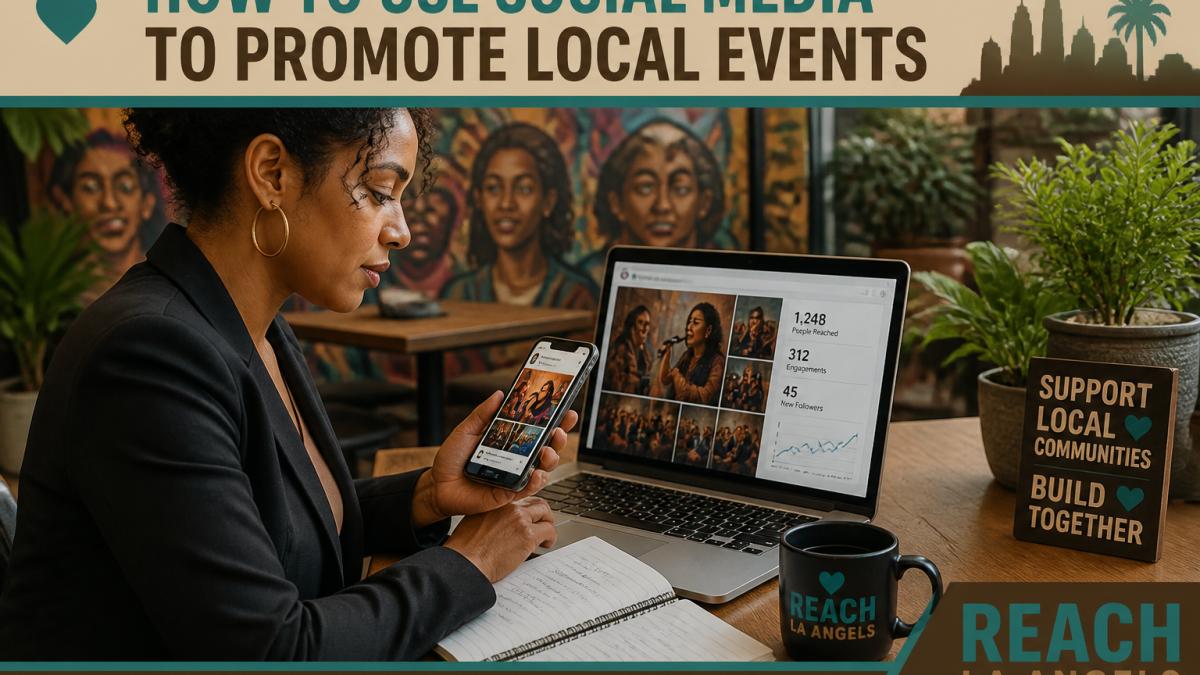
How to Use Social Media to Promote Local Events
Map your LA-specific channels:
Nextdoor is massive in LA. If your event serves a specific neighborhood, post there and engage with the conversation.
Post with LA-specific context:
Don’t just announce the event. Give people a reason to care in the context of their LA life. Traffic and commute matter, mention parking, transit access, walkability. Venue prestige matters, say if it’s a known, respected space. Cultural significance matters, connect to what’s happening in the city.
Instead of “Join us for a live music event,” try “Live music at [venue] on [date].
Create a content rhythm that works for LA audiences:
Post three times per week consistently (How often should a business post on social media? (2025 data)). LA audiences are busy, they need to see your event multiple times before committing. Post evenings (6-9 p.m.) and weekends for community events, weekday mornings for professional events. Use platform-specific content: Instagram Reels differ from TikTok, LinkedIn differs from Twitter. Don’t copy-paste.
Build anticipation with a six-week countdown. Week one: announce and explain why it matters to LA.
Encourage user-generated content and community proof:
Ask attendees to share photos and stories. Tag them, repost their content, and build social proof.
Track which channels actually drive attendance:
The goal isn’t viral content, it’s consistent visibility with the right people on the right channels.
Consistency beats virality. Post regularly to the same audience on the channels where they actually discover events, and you’ll see better attendance than chasing one viral moment on a platform where your audience doesn’t hang out.
Build Your Email List and Run Targeted Campaigns
Email is where you own the relationship. Social media algorithms change. Email inboxes are yours.
Create a simple signup form and place it everywhere: on event listing pages, in your social media bio, at the venue after events, on your website.
Once you have emails, segment them. Don’t send the same message to everyone.
Segment by engagement level:
- Hot: People who attended multiple events or engaged recently
- Warm: People who attended one event or clicked links
- Cold: People who signed up but haven’t engaged
Send hot-segment people new announcements immediately. Send warm-segment people educational content first, why the event matters, what to expect, testimonials.
Segment by event interest:
If you run multiple event types, send people information matching their stated interests. Someone interested in live music doesn’t need emails about art exhibitions.
Avoid the spray-and-pray approach. Sending the same email to your entire list will tank your open rates and get you marked as spam. Segmentation takes five extra minutes and doubles your results.
Event Promotion Templates for Organizers
You need templates to move fast. Here are the core messages every event organizer should have ready.
Email Template: Event Announcement (Send 6 weeks out)
Subject: [Event Name] is happening [date]
Hi [Name],
We’re hosting [Event Name] on [date] at [venue/location]. This is for [who this is for].
[Your name]
Email Template: Urgency/Last Chance (Send 3-5 days before)
Subject: Last chance for [Event Name]
Hi [Name],
[Event Name] is happening [day] at [time]. We’re expecting a full house.
- Doors open at [time]
- Location: [address with directions link]
- Questions? Reply to this email
See you there.
[Your name]
Social Media Caption Template: Event Announcement
[Event Name] is coming [date]. [One sentence: who this is for and why it matters]. [Two sentences: what to expect].
Social Media Caption Template: Testimonial Repost
“[Quote from past attendee]”, [Name]. This is what [Event Name] is about. [Date] at [venue].
These templates save time and keep messaging consistent. Customize with your event details but keep the structure.
Local Influencer Marketing for Events
Influencers in LA aren’t just people with massive followings. Influence is hyperlocal and rooted in cultural credibility.
Identify the right influencers for your event:
Understand why LA audiences trust peer recommendations:
LA event-goers are driven by FOMO, venue prestige, and peer validation.
Reach out with specificity and authenticity:
When you’re ready to partner, reach out directly. Don’t send a generic email.
Be clear about what you’re asking: post once? Attend and share? Bring friends? Mention in their newsletter?
Offer something in return, but keep it real:
Consider offering something: free tickets, a small honorarium, a feature on your platform, or a collaboration on a future event. Many community figures will share events they believe in, especially if you’ve built a genuine relationship. If you’re asking someone with 3,000 followers to promote your event, free admission is reasonable. If you’re asking for custom content or a major push, offer a small honorarium or meaningful collaboration. Be transparent about what you can offer. For events that need professional hosting or curation support, Erica “EMissyK” – Event Host Bookings can bring credibility and cultural authority to your event.
Leverage the power of authentic endorsement:
The best partnerships feel organic, not transactional. When someone shares your event because they believe in it, their audience can tell.
Track the impact of influencer partnerships:
Start with micro-influencers in your specific neighborhood or cultural scene. A DJ with 2,000 followers who knows everyone in your music scene is more valuable than a lifestyle influencer with 50,000 followers who doesn’t know your neighborhood exists. Authenticity and community trust drive attendance in LA.
Tools for Tracking Event Attendance and Performance
You can’t improve what you don’t measure. Track the right metrics, and you’ll see where your promotional efforts actually work.
Start with these core metrics:
Awareness metrics: How many people know your event exists?
- Social media impressions (how many people saw your posts)
- Email open rates (what percentage of people opened your emails)
- Website traffic to your event page
Engagement metrics: How many people are actually interested?
- Click-through rates (people who clicked your event link)
- Social media saves and shares (people saving your post or sharing it)
- Email click rates (people clicking links in your emails)
Conversion metrics: How many people actually attended?
- Total attendees
- Attendees from each promotional channel (how many came from email vs. Instagram vs. word-of-mouth)
- Ticket sales or RSVP rate
Retention metrics: Are people coming back?
- Repeat attendees (people who attended multiple events)
- Email list growth rate
- Social media follower growth
Use simple tools to track these. Google Analytics tracks website traffic. Most email platforms show open rates and click rates. Social media platforms show impressions and engagement.
The key is knowing which channel drives actual attendance. Maybe your Instagram posts get lots of engagement but few actual attendees.
After each event, spend 30 minutes reviewing your numbers. What worked? What didn’t? What will you do differently next time? This feedback loop is how you improve.
Track conversion, not just engagement. A post with 1,000 likes that brings zero attendees is less valuable than a post with 50 likes that fills ten seats.
Grow Your Audience: Next Steps
Growing your event audience isn’t about chasing trends or copying bigger events. It’s about knowing your community, showing up consistently, and building genuine relationships. Start with the fundamentals: clear objectives, audience segmentation, consistent social media presence, and strategic email campaigns. Master those before adding complexity. Then track what works. Every event teaches you something about your audience. Use that knowledge to refine your approach. The events that grow sustainably treat their audience like community, not customers. They show up. They listen. They celebrate attendees. That consistency builds word-of-mouth, the most powerful promotion tool you have.
Frequently Asked Questions
What’s the fastest way to grow your event audience without a huge budget?
Start with what you have: your existing network and social media followers. Use email to reach people who’ve shown interest before. Partner with local organizations and micro-influencers who align with your event’s vibe, they often promote for free if the event fits their community. Focus on one or two channels first rather than spreading yourself thin across everything. Track what’s working and double down on that.
How do you build an authentic audience for multicultural events?
Authenticity starts with knowing your community and speaking directly to them. Use platforms and channels where your target audience already spends time. Be honest about what your event is, who it’s for, and why it matters. Partner with trusted local voices and creators who have real relationships in the community. Avoid generic marketing language, tell the actual story of your event and the people behind it.
What role does social media play in local event discovery?
Social media is where your audience discovers events, shares them with friends, and decides whether to attend. It’s your visibility engine. Instagram, TikTok, and Facebook snippets reach people actively looking for things to do. But more importantly, social media builds community around your event before it happens. Posts, stories, and engagement create momentum and word-of-mouth that no paid ad can fully replicate.
How can event organizers leverage local partnerships to increase turnout?
Partnerships multiply your reach without multiplying your effort. Connect with complementary local businesses, nonprofits, and community organizations. They promote your event to their audiences; you promote theirs. Cross-promotion is free and builds trust because people see the event endorsed by organizations they already know. Start with three to five strategic partners who share your audience or values, then expand from there.
The work starts now. Pick one tactic from this guide, email segmentation, a content calendar, or micro-influencer outreach. Master it. Then add the next one. Growth compounds when you’re consistent and intentional.