
WHEN LEIMERT PARK LAUGHED
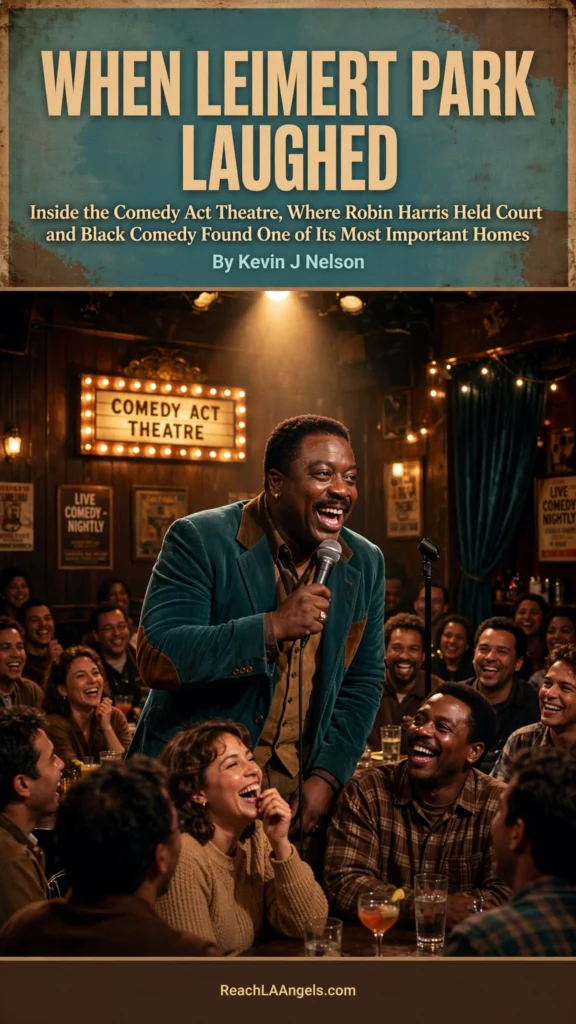
Inside the Comedy Act Theatre, Where Robin Harris Held Court and Black Comedy Found One of Its Most Important Homes
By Kevin J Nelson
There was a time in Los Angeles when you didn’t need Instagram, TikTok or somebody’s list of the hottest places in town to tell you where the culture was.
You just knew.
And if you were outside in Black L.A. during the late ’80s, chances are somebody had told you about this comedy spot over in Leimert Park.
The Comedy Act Theatre.
And if you really knew what was happening, you knew about Robin Harris.
In the beginning, Friday and Saturday nights were the nights. People came out for the weekend, packed the room and helped establish the Comedy Act as one of the places to be.
But then something happened.
Thursday night caught fire.
What might normally have been considered an off-night became the night. Thursday at the Comedy Act developed its own reputation, its own crowd and its own energy. It became the night you wanted to be in the room. You didn’t know who might show up, who might touch the stage or who might be sitting in the audience.
Those Thursdays helped turn a popular comedy club into something iconic.
Going to the Comedy Act wasn’t just about seeing a comedy show. It was a night out.
You got dressed. You called your people. You figured out who was driving. And if it was Thursday night, you already knew where the action was.
People came to see comedians, but they also came because nobody knew exactly what Robin might do next.
Looking back, something much bigger was happening inside that room. The Comedy Act was helping build a pipeline for Black comedians at a time when Hollywood wasn’t exactly overflowing with opportunities for them.
YOU HAD TO BE THERE
It’s hard to explain that era to somebody who has always had entertainment available on demand.
There weren’t clips from last night’s show all over social media. You couldn’t look at somebody’s page and decide whether they were funny before buying a ticket.
You heard about people.
“Man, you gotta go see Robin.”
That was enough.
Word traveled through barbershops, beauty salons, workplaces, radio and everyday conversations. Somebody went to the Comedy Act, had a great time and told five other people.
That was the algorithm.
And Thursday nights became the kind of thing people talked about afterward.
By the time you got there, the energy had already started. People were talking, laughing, checking out who else was in the room.
Then Robin got the mic.
Now it was on.
ROBIN HARRIS WAS DIFFERENT
Calling Robin Harris the host doesn’t quite explain what he did.
Yes, he introduced comedians. But Robin could make the whole room part of his act.
You could almost feel people hoping Robin’s attention landed somewhere else in the room. At the same time, everybody wanted to see what happened when it did.
Robin had an incredible ability to take something completely ordinary, a person’s clothes, the way somebody walked or a comment from the audience, and turn it into comedy.
It wasn’t polished to death. It wasn’t predictable. It felt like something was happening specifically for the people in that room.
His legendary Bébé’s Kids routine would eventually become part of comedy history, and movies introduced Robin to a much larger audience. But people who experienced him live knew there was another level.
You could watch Robin Harris on a screen.
Being in the room when Robin had the microphone was something else.
THIS WAS OUR ROOM
That’s where the Comedy Act story becomes more important than nostalgia.
Black comedians needed rooms like this.
Los Angeles had famous comedy clubs, but getting stage time and having a place where you could really develop your voice weren’t necessarily the same thing.
At the Comedy Act, Black comedians could speak from their own experiences to an audience that understood the culture behind the material. They could get straight to the funny without constantly wondering whether the room would understand where they were coming from.
That freedom matters.
Comedians don’t become great because somebody hands them an HBO special. They become great by getting onstage over and over again.
Trying jokes. Bombing. Rewriting. Coming back. Learning timing. Handling hecklers. Figuring out who they are.
The Comedy Act gave Black comedians somewhere to do that work.
MORE THAN A COMEDY CLUB
When Michael E. Williams opened the Comedy Act Theatre in Leimert Park in 1985, he created more than a nightlife destination.
He created infrastructure.
That may sound overly serious for a place where people came to laugh, but think about what was actually happening.
Black comedians needed a stage. The Comedy Act had one.
They needed an audience. The Comedy Act brought one together.
They needed a place to get better. They had that too.
Then people started talking.
More comedians came. More audiences came. Eventually agents, managers, producers and other industry people started paying attention.
One room was connecting talent, audience and opportunity.
That’s cultural infrastructure in its simplest form.

Are you enjoying this post? We love sharing stories that celebrate Black culture and creativity and your support helps keep it going. As an Amazon Affiliate, Reach LA Angels earns a small commission when you use our links, at no extra cost to you. It’s one of the ways we fund more original content and community features.
Try Prime Video today explore classic comedy specials, documentaries, and new releases that keep the laughter alive.
Then come back and finish the blog you don’t want to miss the rest of When Leimert Park Laughed.
BEFORE EVERYBODY WAS FAMOUS
Looking back at the talent connected to the Comedy Act era is something else.
Robert Townsend. Sinbad. Keenen Ivory Wayans. Martin Lawrence.
And the Black comedy movement that followed would give us a generation that included Jamie Foxx, Chris Tucker, Bernie Mac, D.L. Hughley, Mo’Nique, Dave Chappelle and many others.
We know those names as stars now.
But everybody starts somewhere.
Before the sitcoms, movies, HBO specials, arena tours and big checks, they were comedians trying to make people laugh.
The Comedy Act was one of the places where talent could be seen, tested and developed before the rest of the country caught on.
THEN HOLLYWOOD STARTED SHOWING UP
Eventually Hollywood started coming around.
And that’s an important part of this story.
For years, Black performers had been trying to get into Hollywood rooms, looking for meetings and auditions, trying to convince gatekeepers that Black audiences would support them.
Meanwhile, Black audiences were already supporting Black comedians.
The proof was right there.
So agents came. Managers came. Producers came. People looking for the next great talent started paying attention.
Hollywood was coming to Leimert Park because Leimert Park had something Hollywood needed.
Talent.
And those increasingly legendary Thursday nights became part of that draw. The Comedy Act wasn’t simply somewhere to see established comedians. It was somewhere you might discover who was next.
Years later, Def Comedy Jam would bring an unapologetically Black style of stand-up into millions of homes.
The clothes. The language. The swagger. The crowd. The references. Black comedians talking directly to Black people without stopping to explain themselves.
It felt revolutionary on television.
But the culture had already been doing it.
The clubs had been developing it. The comedians had been working it out. Black audiences had already approved it.
The Comedy Act was part of that foundation.
LEIMERT PARK MATTERED
And the location wasn’t incidental.
Leimert Park has long been one of the cultural hearts of Black Los Angeles, a place for art, music, poetry, business, politics, food and community.
The Comedy Act belonged there.
You weren’t simply entering a comedy club. You were walking into a Black cultural space, in a Black neighborhood, to watch Black performers speak directly to Black audiences.
For those few hours, nobody needed anybody else’s permission to be at the center of the story.
MAN, WE USED TO GO OUT
And yeah, some of this is just nostalgia.
Because we used to go out.
Really go out.
You got dressed and went somewhere.
And Thursday at the Comedy Act was proof that you didn’t have to wait for the weekend.
Thursday became the weekend.
You didn’t already know every joke because somebody uploaded the comedian’s whole set. You heard about a place and had to actually go there to understand why everybody kept talking about it.
Afterward, you stood outside discussing the show.
You talked about it on the ride home.
The next day somebody heard:
“Man, you should’ve been there.”
And they really should have been there.
There was no replay.
The moment belonged to the people who were in the room.
AND THEN ROBIN WAS GONE
Robin Harris died in 1990 at only 36 years old.
Even now, 36 doesn’t sound right.
His national profile was growing. Film audiences were discovering him. Bébé’s Kids had become legendary. It seemed like the rest of America was finally catching up to what Los Angeles already knew.
Then he was gone.
But real influence doesn’t disappear that easily.
You can still hear pieces of Robin’s approach in comedy today, in crowd work, improvisation and that ability to turn regular Black life into something an entire room recognizes immediately.
Some comedians influence people through television.
Some through movies.
Robin Harris influenced people through rooms.
And one of the most important was in Leimert Park.
WHAT A TIME
The Comedy Act Theatre was more than somewhere to catch a show. It was one of those rare places where the right talent, the right audience and the right moment all came together.
It started with those Friday and Saturday nights.
But Thursday became legendary.
The kind of night where you wanted to be there because you never knew who might walk through the door or what might happen once Robin grabbed that microphone.
Today we have streaming, podcasts, viral clips and comedians selling out arenas. Back then, all somebody had to say was:
“You going to the Comedy Act Thursday?”
If you knew, you knew.
That was the Comedy Act.
That was Robin Harris.
That was Leimert Park.
And man, what a time to be in Black L.A.
Founder’s Closing
As the founder of Reach LA Angels, I carry a deep love for the spaces and stories that shaped us and the Comedy Act Theatre is one of those rare places where culture wasn’t just happening, it was being built. Honor is due to Michael E. Williams. Robin Harris, Leimert Park, those Thursday nights… they remind us that Black creativity has always thrived when we create rooms for each other.
If this story brought back memories, taught you something new, or simply made you smile, then it’s doing exactly what it was meant to do. Our mission is to honor the people, places, and moments that made Black L.A. unforgettable and to keep that energy alive for the next generation.
Thank you for reading, for supporting, and for showing up for the culture. There’s more to explore, more to celebrate, and more stories ahead.
Be sure to checkout our events our events page or submit your event to our calendar.